
Abstract
The article examines the judgment of the Milan Court, 11 November 2025, no. 8613, concerning the protection of photographs and the limits of copyright exceptions. The decision classifies a news photograph as a photographic work under Article 2(7) of Law no. 633 of 22 April 1941, reaffirming the central role of the minimum threshold of creativity as the dividing line from “simple photographs” governed by Articles 87 ff. of the Italian Copyright Act (“L.d.A.”). With regard to exceptions, the Court excludes the applicability of the news reporting defence under Article 65(2) L.d.A., clarifying that political commentary and the expression of opinion do not automatically justify the reproduction of an image, especially when it is decontextualized and not necessary for an informational purpose. The commentary finally focuses on the quantum debeatur, highlighting the critical issues of equitable damage assessment and the implications of this choice for the effectiveness of copyright protection in the context of digital communication.
The (unauthorized) political exploitation of an authorial photograph
Judgment no. 8613/2025 of the Milan Court arises from the use, on social networks, of an internationally award-winning photograph taken by the Italian photographer Massimo Sestini, without the author’s consent.
The photograph, taken during a search and rescue operation in the Mediterranean Sea as part of Operation Mare Nostrum, depicts a migrant boat from above and has become over the years one of the iconic images of the migration phenomenon. The shot received wide public recognition, winning second prize in the “General News” category of the 2015 World Press Photo Contest, and was subsequently disseminated and used in editorial and institutional contexts.
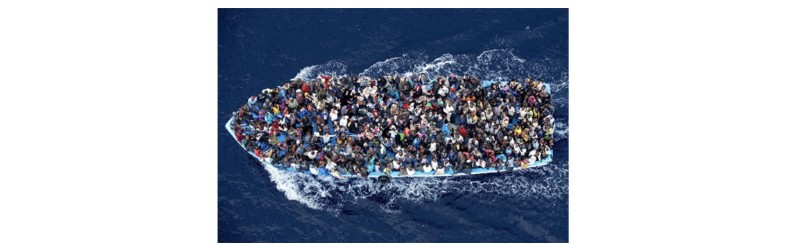
As a matter of fact, Sestini alleged that the photograph had been used in 2022 on several social media platforms (Twitter, Facebook and Instagram) by a person holding a public and politically exposed profile, as an accompaniment to a post with political content, without any authorization to use the image and without indication of the author’s name.
The contested use was not limited to a neutral sharing, but was intended to reinforce a political message extraneous to the original context of the shot. In particular, the photograph was accompanied by the caption “BREAKING NEWS – MIGRANTS: mass landing in Sicily, there are 5 dead” and followed by the user’s comment:
“More deaths, more landings, more money for traffickers means more suffering for everyone.
We need to change, we can change.
With the vote of Italians, from 25 September security and courage will return.” (the courtesy translation is made by the undersigned)
According to Sestini, such conduct amounted to an exploitation of the image for political communication purposes, capable of affecting not only the economic exploitation rights in the work, but also the author’s moral right, through the association of the photograph with a political message neither shared nor authorized.
The defendant – a politically exposed public figure – instead argued that the publication was lawful, invoking the public interest in the news and the exercise of the right of reporting and commentary. On this basis, the Court was called upon to rule on the legal classification of the photograph and, above all, on the limits within which the use of news photographs can be considered lawful when inserted into a context of political commentary.
The “creative threshold” in the protection of journalistic photographs
As a preliminary matter, the Milan Court reconstructs the system of protection afforded to photographs, starting from the now-consolidated distinction between photographic works and simple photographs. The photograph at issue is examined in light of Article 2(7) L.d.A., which includes among the works protected by copyright “photographic works and those expressed by a process analogous to photography”.
As the Court observes, copyright law distinguishes between different situations corresponding to different levels of protection. In particular, case law identifies three categories:
- photographs endowed with a particular degree of creativity, protected as works of authorship under Article 2(7) L.d.A., with full application of Articles 12 ff., 20 ff. and 171 ff. l.d.a.;
- simple photographs, less artistic, to which the legal system grants a reduced protection through the related rights set out in Articles 87 ff. L.d.A.;
- images devoid of any creative contribution, such as photographs of writings, documents, business papers, material objects or similar products, which are excluded from copyright protection under Article 87(2) L.d.A.
(It should be noted that this distinction is today destined to lose part of its systematic relevance in light of the amendments introduced by the so-called “Simplification Decree,” which extended the term of protection for simple photographs from 20 to 70 years, bringing them significantly closer to the regime of works of authorship. see: La tutela delle fotografie semplici passa fa 20 a 70 anni, Canella Camaiora Law Firm)
Within this framework, the Supreme Court has clarified that the dividing line between a protected work and a simple photograph does not lie in the aesthetic value or technical quality of the shot, but in the author’s personal imprint. As stated by the Court of Cassation:
“The dividing line between a protected work and a simple photograph is centered on the author’s creative capacity, that is, on his personal imprint, in the choice and study of the subject to be represented, as well as in the executive moment of realization and reworking of the shot, such as to evoke impressions that transcend the ordinary appearance of the represented reality”
(Cass. civ., Section I, no. 33599 of 20 December 2024).
Simple photographs, on the other hand, differ from works of authorship because they require no creative contribution from the photographer, amounting to a mere reproduction of external reality, even if technically refined. According to the Court of Cassation, they:
“are limited to faithfully reproducing external reality, without any personal and substantial reworking of the photograph by the author”
(Cass. civ., Section I, no. 33599/2024).
Consistently, lower-court case law has clarified that the quid pluris of creativity can be found in the choice of the expressive moment, technical means and effects used, such as – by way of example – light, framing, focus and perspective (Trib. Roma, 11 marzo 2021, n. 4361; Trib. Napoli, ord. 24 gennaio 2025, R.G. 26286/2024).
In the absence of such creative elements, the photograph remains subject to the regime of simple photographs under Articles 87 ff. L.d.A., with protection also conditional upon compliance with the information obligations under Article 90 L.d.A. (indication of the photographer’s name, the date of production and the name of the author of the photographed work).
Applying these principles to the case at hand, the Court held that the photograph in question qualifies as a photographic work under Article 2(7) L.d.A., as it displays a recognizable creative contribution and is not merely executory (see Milan Court, no. 2958/2025, issued on the same photograph).
According to the Court, the shot clearly differs from a purely reproductive photograph, as it does not simply document a real event but is the result of conscious expressive choices attributable to the author.
- First, the shooting technique is relevant: an overhead view of the subject – a crowded migrant boat – obtained from a helicopter using the so-called zenithal technique, i.e. from above downward, in perfect perpendicularity between the shooting point and the subject. This choice defines and enhances all elements of the composition, giving the image an immediately recognizable visual structure.
- Added to this is the selection of the moment of the shot, which does not appear random: the photograph is taken at an instant when (almost) all migrants on board look upward, establishing a direct relationship with the shooting point. This circumstance, according to the judge, also denotes a studied and deliberate shot, expressive of a degree of creativity that goes beyond mere technical skill.
The Court further emphasizes that the photographer was able to capture a detail of the migrants’ real life, enriching it through his technical ability and transforming it into an image with strong evocative power, capable of symbolically representing the human drama underlying the migration phenomenon. In this sense, the shooting method does not merely represent factual data, but conveys an additional message attributable to the author’s personal vision.
The conclusion as to the creative nature of the photograph is further corroborated, from an evidentiary standpoint, by the recognition received from technically qualified bodies:
- the shot won second prize in the “General News” category of the 2015 World Press Photo Contest and was used by National Geographic as the cover of its June 1, 2019 issue.
While not constituting a requirement for copyright protection, these elements are valued by the Court as symptomatic indicators of the expressive quality of the work, already inferable from its intrinsic characteristics.
In light of these considerations, the Court held that the photograph displays a high degree of creativity, resulting from the author’s ingenuity, and must therefore be classified as a photographic work under Article 2(7) L.d.A., with the consequent application of the full copyright regime.
The right of reporting: When the exception does not apply (and why)
In motivating the exclusion of the defence invoked by the defendant, the Milan Court starts from the normative framework of Article 65 L.d.A., implicitly recalling its function and limits. As is well known, this provision introduces a derogation from the general rules of copyright, allowing the reproduction or communication to the public of protected works in the name of the public interest in information, but only under strict conditions.
In particular, Article 65(2) L.d.A. allows the use of protected works exclusively:
i) on the occasion of current events;
ii) solely for the exercise of the right of reporting;
iii) within the limits of the informational purpose.
As consistently affirmed by case law, this is an exception of strict interpretation, which cannot be extended beyond cases in which reproduction of the work is necessary to inform the public about a current fact.
It is precisely on this point that the Court focuses its negative assessment. The judge clarifies that, in the present case, the conditions for applying the exemption are lacking, since the contested conduct does not constitute an exercise of the right of reporting, but rather falls within the sphere of expression of opinion. As stated verbatim in the judgment:
“The episodes at issue constitute a legitimate expression of thought, but not an exercise of the right of reporting, which occurs in the presence of an activity of impersonal narration or recording of facts according to their chronological succession”
(the courtesy translation is made by the undersigned)
This passage is decisive. The Court does not deny that the topic addressed is of public interest, nor does it question the defendant’s freedom of expression. What is excluded is that the use of the photograph can be traced back to an informational activity in the strict sense, namely an impersonal and chronologically anchored narration of facts.
Upon closer examination, an additional element also emerges – left in the background by the judge but particularly significant – namely the temporal and factual distance between the image and the post. The photograph dates back to 2014, while the social media post was published in 2022, in a completely different context and without any direct connection to a specific current event to be documented. The image is thus decontextualized and reused as visual support for a general political message, losing any immediate informational function.
This distance directly affects the applicability of Article 65 L.d.A.: the further removed the image is, in time and context, from the fact it is supposed to document, the more evident it becomes that its reproduction is not necessary to inform, but rather serves to reinforce, evoke or make more incisive a standpoint. In such cases, the exception cannot apply, because the work is not used for reporting, but for commentary.
This is precisely where the boundary drawn by the judgment lies: the right of comment does not automatically entail the right to reproduce the photograph. The expression of an opinion, even on matters of great public relevance, does not in itself legitimize the use of the image when it is not strictly functional to understanding the news. Otherwise, Article 65 would risk turning into a generalized license for image use, especially on social networks.
(Why, then, is the photograph reproduced here?)
At this point, the attentive reader might legitimately ask why, in this article, the photograph at issue is nevertheless reproduced. The answer is simple – and lies in another exception.
Here, the image is used in degraded form and with credit indication, exclusively as the direct object of legal analysis, within a commentary on a judicial decision. The reproduction does not serve to reinforce a political message, nor to evoke the symbolic content of the shot, but to allow the reader to identify the work under discussion. This is therefore a use traceable to Article 70 L.d.A., which allows the reproduction of protected works within the limits justified by purposes of criticism, discussion and study, provided that it does not compete with the economic exploitation of the work.
In other words, here the photograph does not “speak” in place of the text: it is the text that speaks about the photograph. And legally, that makes all the difference.
The quantum debeatur: When protection stumbles at the compensatory stage
If, with regard to the legal classification of the work and the exclusion of the defences, the Milan Court’s judgment appears solid and convincing, the greatest critical issues emerge in the determination of the quantum debeatur. It is precisely here that the commentary on the decision cannot stop at merely acknowledging the final outcome, but must reconstruct the logical-numerical path followed by the judge.
The Court starts from a correct premise: once the infringement of the author’s economic exploitation rights is established, damage exists in re ipsa, and the claimant is not required to prove its existence. Referring to Supreme Court case law, the judge states that the violation of exclusive rights “in itself constitutes proof of the existence of damage”. However, immediately after this statement of principle, the reasoning shifts to a different plane, introducing a series of mitigating factors that decisively affect the final quantification.
In particular, the Court emphasizes two elements: on the one hand, the fact that the claimant neither alleged nor proved how long the photograph remained visible on the defendant’s social media profiles; on the other hand, the absence of a prior cease-and-desist notice requesting removal of the image. On this basis, the panel deems it “reasonable” to award a minimal sum, quantifying the pecuniary damage at € 700.00 for each unlawful publication, up to a total amount of € 3,500.00 for five posts.
This passage is central, because it reveals a substantially lump-sum approach to quantification, not anchored to shared economic parameters. The judgment does not explain why exactly €700 should represent the reasonable equitable value of the use of an internationally renowned photograph, nor does it clarify the relationship between this amount and market rates, licensing practices or the criteria put forward by the claimant. The figure appears in the reasoning as a conclusive datum, rather than as the result of a genuine economic assessment.
A similar approach emerges in the quantification of non-pecuniary damage for infringement of the author’s moral right, set at approximately one third of the pecuniary damage (about € 1,200), without any explicit explanation of the criterion justifying this proportion. The choice appears more like a practical coefficient than the outcome of an autonomous evaluation of the harm suffered by the author in terms of attribution and undue (moral) association of the work.
Finally, the Court entirely excludes compensation for the violation of the author’s personality and political identity rights, considering the claim affected by “insurmountable deficiencies of allegation even before proof”. Also in this respect, the decision adopts a strongly restrictive approach, which ends up neutralizing any compensatory relevance of the politically connoted use of the image.
It is at this point that the most evident fracture of the judgment emerges.
- On the one hand, the judge firmly affirms the unlawfulness of the conduct and the full copyright protection of the photograph;
- on the other, the compensation is reduced to an amount that risks appearing merely symbolic, especially when compared to the communicative impact of the image and the visibility of the person who used it.
This approach raises a fundamental question: can copyright protection be considered effective if, in the face of an established unlawful use, compensation is systematically compressed on the basis of criteria that have little to do with the real value of the work? Anchoring the assessment to the duration of online availability or to the absence of a prior warning means applying parameters designed for analogue contexts to dynamics – those of social networks – in which value is concentrated in immediacy and symbolic force.
The risk, therefore, is that copyright infringement comes to be perceived as a predictable and sustainable cost, rather than as conduct genuinely discouraged by the legal system.
And it is precisely here that the commentary on the judgment finds its deepest meaning: not in challenging the affirmation of principles, but in highlighting how strong protection in the abstract may prove weak in practice, if the moment of economic quantification is not supported by criteria consistent with the realities of contemporary communication.
Data di pubblicazione: 5 Gennaio 2026
© Canella Camaiora S.t.A. S.r.l. - Tutti i diritti riservati.
È consentita la riproduzione testuale dell’articolo, anche a fini commerciali, nei limiti del 15% della sua totalità a condizione che venga indicata chiaramente la fonte. In caso di riproduzione online, deve essere inserito un link all’articolo originale. La riproduzione o la parafrasi non autorizzata e senza indicazione della fonte sarà perseguita legalmente.

Joel Persico Brito
Graduated from the Università Cattolica del Sacro Cuore in Milan, trainee lawyer passionate about litigation and arbitration law.