Abstract
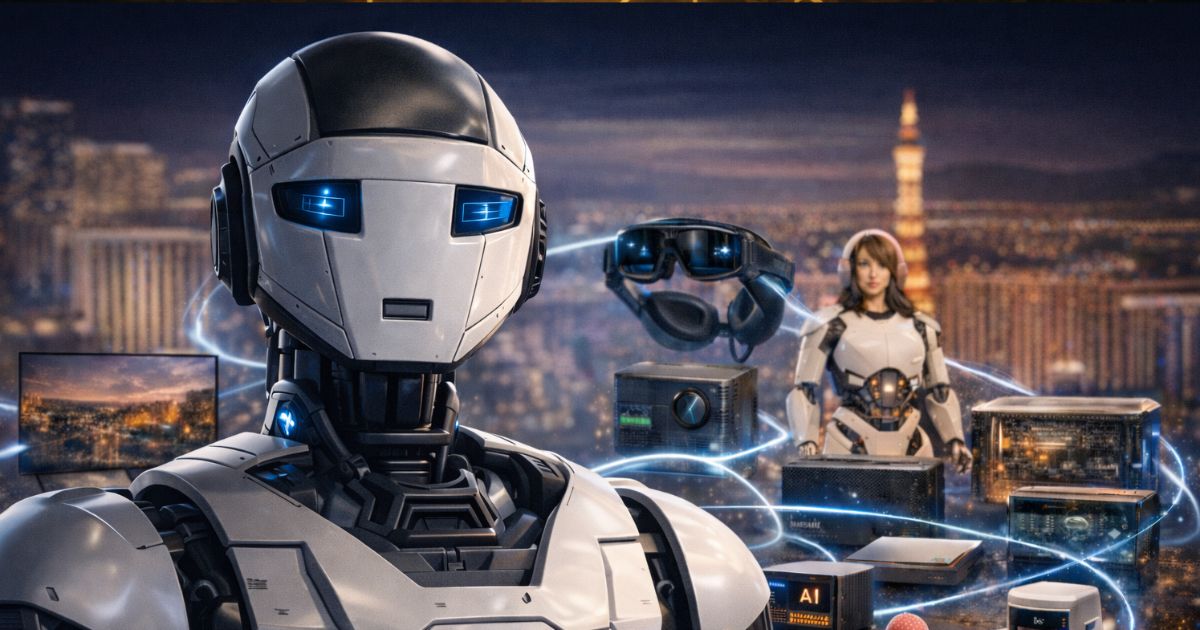
CES 2026 (the Consumer Electronics Show in Las Vegas) marked a decisive turning point: artificial intelligence is no longer a novelty, but a baseline condition. From domestic robots (still somewhat awkward) to advanced driver-assistance systems and digital health solutions, technology no longer seeks permission—it enters processes, products, and workplaces as a given.
This article outlines what emerged from the CES exhibition halls, but above all what it means for businesses. Because while startups scale rapidly and major players release increasingly ambitious roadmaps, standing still is now tantamount to falling behind.
The future is decided in Las Vegas!
Every January, Las Vegas becomes the nerve center of global technology. Yet CES is no longer merely a showcase for futuristic gadgets. The 2026 edition—with over 148,000 attendees from around the world and more than 4,100 exhibitors (including 1,200 startups)—confirmed an uncomfortable truth for companies: this is not where technology is observed; this is where the future is shaped.
The strong presence of senior executives—more than half of all attendees—speaks volumes. CES is no longer a venue for curiosity; it is a place for decision-making. Companies observe, analyse, and enter into agreements. It is not a trade fair; it is a strategic laboratory. As Gary Shapiro, CEO of the Consumer Technology Association, stated, CES is “more than a showcase: it is where technology meets community, business, and policy.”
The innovations unveiled here do not remain prototypes. They become standards, operating models, and benchmarks. Within weeks, they find their way into industrial plans, consumer products, and the services we use daily. Moreover, CES is no longer confined to consumer electronics: many solutions designed for domestic use are rapidly migrating into professional environments, accelerating transformation in sectors previously considered unaffected.
CES has therefore become a magnifying glass on the future of business. Observing what emerges from its exhibition halls means anticipating the direction of markets, regulation, and investment. Those who remain stationary risk being left to chase developments after the fact.
This year, amid robots, intelligent vehicles, and digital health solutions, one message emerged clearly across sectors: one technology is everywhere—integrated, invisible, yet dominant.
The end of Artificial Intelligence (as a tool)
Walking through CES 2026, one fact was immediately evident: artificial intelligence is no longer an optional feature—it is the core of everything. From automotive to healthcare, from robotics to consumer electronics, AI was not announced or highlighted. It was assumed. Embedded. Invisible. And omnipresent.
This is not a mere technological shift; it is a paradigm change. We are no longer discussing “digital transformation”, but something more profound: an intelligent transformation in which AI reshapes roles, processes, and expectations. For businesses, this has a clear implication: the era of pilot projects is over. AI has become infrastructure.
Wherever data exists, an algorithm is reading it and deciding how to act. Virtual assistants that converse naturally inside vehicles. Industrial systems that self-optimise. Even so-called “emotional” pet robots—such as Ecovacs’ Famibot LilMilo—capable of following their owner, responding to touch, and recognising voices. Not mere toys, but companions for those unable to keep real animals.

Famibot LilMilo, the AI “puppy” robot presented at CES 2026 (image via TechRadar, credit: Future).
This is not spectacle; it is a signal. As Bernard Marr, futurist and strategic advisor, explains, AI is no longer a tool to be activated when needed, but a constant presence operating in the background—making decisions and guiding processes. In his Forbes article “Why CES 2026 Signals the End of ‘AI as a Tool”, Marr identifies this transition as the true inflection point.
One sector where this shift is particularly evident is digital health. At CES 2026, AgeTech demonstrated how monitoring, prevention, and daily assistance have become components of a new market. Devices such as the Withings Body Scan 2 do not merely collect data; they process cardiovascular and metabolic indicators and suggest concrete actions—effectively functioning as a continuously listening virtual physician.
This development, however, raises critical questions. As AI enters healthcare management, issues of trust, data protection, and liability become unavoidable. Who safeguards sensitive health data? Who bears responsibility when an automated system fails? For companies, this translates into new governance and reputational challenges, particularly when such solutions are integrated into corporate welfare programmes or insurance services.
And while AI quietly permeates everyday life, another frontier promises to redefine what we consider possible: humanoid robotics and intelligent mobility—apparently ready for market… or perhaps not?
Robots drive perfectly, but still cannot fold the laundry
The North Hall at CES 2026 felt like a science fiction set. Humanoid robots, mechanical arms, and autonomous assistants occupied the stage as never before. The novelty, however, was not merely visual: these were not laboratory prototypes, but products claimed to be close to market readiness.
Then came the reality check.
LG’s domestic robot CLOiD, for instance, drew attention for its ability to fold laundry and serve food. Yet, as reported by Engadget, it does so “very slowly”. In practical terms: it can perform the task, but not efficiently enough to be genuinely useful.
Similar caution was expressed by the Associated Press, which acknowledged the enthusiasm and investment in the sector but highlighted persistent limitations in dexterity, reliability, and scalability. Tom’s Guide was even more direct, noting that the live laundry-folding demonstration “did not go well.” The underlying issue is clear: manipulating soft materials remains a formidable challenge for machines, even highly advanced ones.
In short, while AI is already embedded in everyday life, humanoid robotics is still searching for a truly viable role in domestic settings—at least for now.
The situation is markedly different in mobility, where technological maturity is tangible. Several automotive manufacturers have moved beyond futuristic concepts, focusing instead on software and AI to enhance existing vehicles.
Mercedes-Benz, for example, announced that the new CLA model will be equipped with MB.OS, an operating system developed in collaboration with NVIDIA. The objective is to bring AI onboard, enabling over-the-air updates and Level 2 assisted driving even in complex urban environments.
What does Level 2 mean?
It is an internationally recognised classification of vehicle automation: the car can simultaneously manage steering, acceleration, and braking, but the driver must keep their hands on the wheel and remain attentive. In essence, the vehicle assists—but does not drive autonomously.
This evolution is not limited to industry giants. Hyundai unveiled its “AI Robotics Strategy,” based on three concrete actions:
- initiating human–robot collaboration in real production environments;
- building a fully integrated AI Robotics value chain across its affiliates;
- forming strategic alliances with leading global AI players.
These initiatives are supported by data-driven production systems such as RMAC and the Software-Defined Factory, as well as strategic partnerships with Boston Dynamics and Google DeepMind to develop safe and efficient humanoid robots.
This approach has already received formal recognition: Hyundai Motor Company won the Best of Innovation Award 2026 in the Robotics category with MobED, a four-wheel mobile platform with independent suspension designed to navigate uneven terrain while transporting loads or sensors.
Cars update themselves. Robots converse. The real question, however, is different: how can a company remain competitive in 2026?
For businesses, waiting is no longer an option
If CES 2026 made one thing clear, it is this: remaining competitive no longer requires a groundbreaking invention—but it does require the integration of AI.
Artificial intelligence is no longer an experimental domain for early adopters. It is the operational standard. Companies that still treat AI as a “side project” risk exclusion as benchmarks shift—quietly but inexorably—across all sectors.
Agriculture, manufacturing, logistics, financial services: there are no longer any safe harbours. Intelligent automation reduces costs, shortens timelines, improves forecasting, and rewrites entire value chains. For SMEs and startups, the moment to change pace is now:
- either select a limited number of concrete use cases and scale them with discipline;
- or be overtaken by competitors.
The good news is that these technologies are far more accessible than commonly assumed.
Cloud infrastructure, AI-as-a-Service platforms, and low-cost IoT sensors offer powerful, often plug-and-play tools even to organisations without billion-euro budgets. The real challenge is organisational rather than financial: measuring return on investment, managing data effectively, ensuring security and integration.
Nor is it necessary to reinvent everything from scratch. The presence of over 1,200 startups at CES confirms that innovation today is modular—ready to be adopted, integrated, and combined. Competitive advantage is not built through code alone; it is built through strategic choices.
The most delicate—and most strategic—terrain remains labour.
Large Language Models (LLMs) and new software agents are already capable of automating repetitive tasks, analysis, and customer care. Yet every automated step shifts value:
- towards those who can formulate the right questions,
- those who can verify the answers,
- those who can manage exceptions,
- and those who ultimately assume responsibility.
This is where the real challenge lies. It is not merely about adopting technology, but about reshaping mindsets, roles, and organisational culture.
Upskilling and reskilling are no longer HR initiatives; they are survival strategies.
Because in an accelerating market, success belongs not to those who possess AI, but to those who can transform it into reliable, repeatable processes. And that—more than any demonstration—is the lesson businesses should take home from Las Vegas.
Data di pubblicazione: 19 Gennaio 2026
© Canella Camaiora S.t.A. S.r.l. - Tutti i diritti riservati.
È consentita la riproduzione testuale dell’articolo, anche a fini commerciali, nei limiti del 15% della sua totalità a condizione che venga indicata chiaramente la fonte. In caso di riproduzione online, deve essere inserito un link all’articolo originale. La riproduzione o la parafrasi non autorizzata e senza indicazione della fonte sarà perseguita legalmente.

Martina Di Molfetta
Graduated in Communication, Innovation, and Multimedia from the University of Pavia.