
Abstract
The judgment of the Council of State of 11 April 2025 (No. 3118/2025) marks the first significant judicial application of article 10 of Decree-Law No. 16/2020 on ambush marketing. The Zalando case clarifies when a marketing communication may amount to parasitic advertising within the meaning of the statute.
The Court identified two key elements: the creation of an association between a brand and a major event, and the communication’s capacity to mislead the public as to the identity of the official sponsors. It characterised the infringement as an offence of concrete endangerment, meaning that proof of actual deception is not required.
In light of the enforcement initiatives undertaken by the Competition Authority (AGCM) during Olympics Milan-Cortina 2026, the ruling now has clear practical significance.
When does a reference to a major event cross the line into unlawfulness? What exposure do non-official sponsors face?
The case offers useful criteria for distinguishing between lawful evocative advertising and prohibited ambush marketing.
The Zalando case and the first judicial interpretation of the ambush marketing regime
In its judgment of 11 April 2025, the Sixth Chamber of the Council of State addressed what can properly be regarded as the first substantial judicial interpretation of the ambush marketing regime introduced by Decree-Law No. 16 of 11 March 2020 (converted into Law No. 31 of 8 May 2020).
The Court upheld the administrative fine imposed by the AGCM, thereby providing authoritative guidance on legislation specifically designed to protect the commercial value of major sporting and trade fair events. Although the decision was delivered last year, it deserves renewed attention: the investigations launched in connection with Milan-Cortina 2026 demonstrate that the statutory framework has now entered a mature enforcement phase.
The proceedings arose from a promotional campaign conducted by Zalando during UEFA Euro 2020. A billboard displayed in Piazza del Popolo in Rome, close to the official “Football Village”, featured the Zalando logo, the image of a white football jersey, the flags of the 24 participating national teams, and the slogan “Who will be the winner?”.
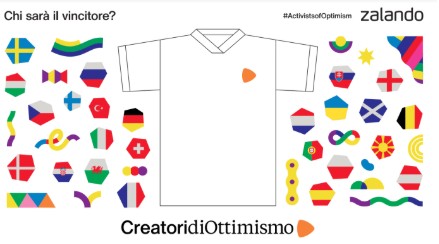
According to the AGCM, the overall content and strategic placement of the advertisement were capable of suggesting a commercial link between Zalando and the tournament, potentially leading consumers to assume that the company was an official sponsor. The conduct was therefore classified as parasitic advertising under Article 10(2)(a) of the Decree-Law, and a fine of €100,000 was imposed.
The Lazio Regional Administrative Court dismissed Zalando’s appeal (Judgment No. 13478/2023), and the Council of State confirmed that ruling in full. The higher court endorsed the Authority’s reasoning and clarified the interpretative criteria applicable to Article 10.
The case forms part of a broader enforcement trend. The AGCM’s scrutiny of marketing campaigns deemed to evoke the Milan-Cortina 2026 Games signals that ambush marketing is no longer a purely doctrinal concept but a concrete compliance issue capable of affecting corporate advertising strategies in connection with high-profile events.
To appreciate the full scope of the Zalando decision, it is necessary to examine the structure of article 10 of Decree-Law No. 16/2020 and the types of conduct it prohibits.
The structure of article 10: general clause and specific prohibitions
The article 10 of Decree-Law No. 16/2020 establishes a comprehensive prohibition on certain forms of unauthorised commercial exploitation of major events.
The provision begins with a general clause, which prohibits: Parasitic, fraudulent, misleading or deceptive advertising or commercial activities carried out in connection with the organisation of sporting or trade fair events of national or international relevance, without the authorisation of the organisers and for the purpose of obtaining an economic or competitive advantage.
The rule therefore targets unauthorised commercial practices linked to major events, where these are designed to secure an economic or competitive benefit.
The statute then sets out four specific categories of prohibited practices.
- First, it prohibits the creation of a direct or indirect association between a brand and an event where that association is liable to mislead the public as to the identity of the official sponsors.
- Second, it forbids falsely claiming official sponsorship status.
- Third, it covers promotional initiatives carried out during the event without authorisation where they may generate the mistaken impression of a sponsorship relationship.
- Finally, it prohibits the marketing or sale of products unlawfully bearing the event’s logo or other signs capable of causing confusion.
In defining ambush marketing, the Council of State referred to the 2014 European Sponsorship Association Policy Paper, which distinguishes between three recurring practices: ambush by association, ambush by intrusion, and opportunistic marketing. This comparative reference situates the Italian framework within a broader European debate on the protection of sponsorship investments.
Yet the statutory taxonomy alone does not resolve the core issue: how should the association between brand and event be assessed in practice, and at what point does it become legally problematic?
Association and misleading effect: the court’s method of assessment
The central contribution of the Zalando ruling lies in its clarification of the evidentiary and interpretative method.
The Council of State emphasised that the assessment must be global and contextual. No single element of the advertisement was decisive in isolation. Rather, it was the combined effect of content, imagery, wording, and physical placement that mattered.
The proximity of the billboard to the official “Football Village”, the presence of national flags, the football imagery, and the competitive slogan were considered together. Viewed as a whole, these elements were capable of establishing an implicit association with the tournament and displayed a concrete capacity to mislead consumers as to the existence of a sponsorship relationship.
The Court therefore confirmed that two cumulative conditions must be met under Article 10(2)(a):
- The creation of an association, even indirect, between the brand and the event; and
- The objective capacity of that association to mislead the public regarding official sponsorship.
Importantly, the infringement qualifies as one of concrete endangerment. The Authority is not required to demonstrate that consumers were actually deceived. It suffices that the communication, assessed in its overall context – content, timing, and mode of dissemination – is capable of producing a misleading impression.
This approach significantly broadens the compliance perimeter. Not every reference to a major event is unlawful; what matters is whether the communication moves beyond legitimate thematic reference and becomes capable of generating a false perception of official affiliation.
Milan-Cortina 2026 winter Olympics: enforcement practice and corporate risk exposure
The practical relevance of the Zalando judgment became evident during the Milan-Cortina 2026 winter Olympic and Paralympic Games, when the AGCM initiated several proceedings for alleged ambush marketing.
On 30 January 2026, the Authority opened an investigation against Harmont & Blaine S.p.A. concerning online and social media communications deemed evocative of Olympic symbols, including the use of event-related hashtags.
On 19 February 2026, further proceedings were launched against Rialto S.p.A. in relation to the “TecnOlimpiadi” campaign and against MD S.p.A. for the “Start of the Olympic Games – MD Edition” campaign, both of which relied on references to Olympic imagery. On the same day, the Authority issued a moral suasion measure against SELEX Gruppo Commerciale S.p.A..
A notable feature of these interventions is their timing: the AGCM acted during the period of maximum media exposure, signalling a willingness to enforce Article 10 dynamically and in real time.
In line with the principles articulated by the Council of State, the Authority appears to have evaluated the campaigns holistically. Full reproduction of protected logos was not necessary; a combination of visual, linguistic, and contextual references could suffice to create a problematic association.
For companies that are not official sponsors, the legal risk therefore extends beyond trademark infringement in the strict sense. The decisive question is whether the marketing strategy constructs a perceptible and misleading association with the event, even without explicit claims of sponsorship.
Milan-Cortina 2026 winter Olympics thus represents the first large-scale enforcement test of the 2020 regime. Through the interaction between the AGCM and the administrative courts, the boundary between legitimate event-related marketing and prohibited parasitic advertising is gradually being defined with increasing precision.
Data di pubblicazione: 26 Febbraio 2026
© Canella Camaiora S.t.A. S.r.l. - Tutti i diritti riservati.
È consentita la riproduzione testuale dell’articolo, anche a fini commerciali, nei limiti del 15% della sua totalità a condizione che venga indicata chiaramente la fonte. In caso di riproduzione online, deve essere inserito un link all’articolo originale. La riproduzione o la parafrasi non autorizzata e senza indicazione della fonte sarà perseguita legalmente.