Abstract
Does an infringement of the “right to be forgotten” automatically give rise to a claim for damages?
In its decision No. 6433 of 18 March 2026, the Italian Supreme Court clarified that the delayed delisting of online content that is no longer current does not automatically entitle the data subject to compensation.
The claimant must prove both the damage suffered and the causal link between that damage and the continued online accessibility of the information, including by way of presumptive evidence where appropriate. The ruling forms part of the broader balancing exercise between the protection of reputation, the right to be forgotten and the freedom of information.
The right to be forgotten: erasure, delisting and the balancing of competing interests
To fully appreciate the significance of Supreme Court decision No. 6433/2026, it is first necessary to distinguish between the right to be forgotten, erasure, and delisting—concepts that are closely related but not interchangeable.
The right to be forgotten entitles an individual not to remain indefinitely associated with information concerning them where such information, although originally lawful and accurate, has become outdated and no longer serves a genuine and current public interest. In the online environment, news reports and personal data may continue to surface many years after the underlying events occurred, thereby affecting the individual’s reputation and social identity.
Depending on the circumstances, data subjects may rely on a range of legal remedies, including requesting that information be updated or supplemented, seeking its erasure, or requesting its delisting from search engine results.
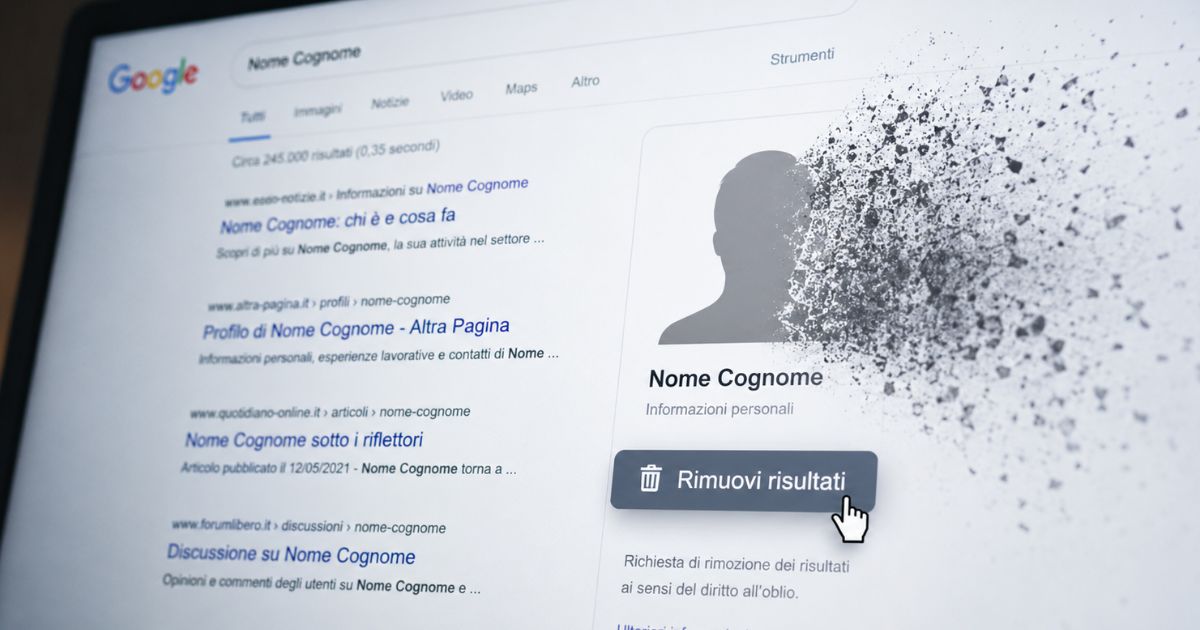
Unlike erasure, which requires the publisher of the content and/or the operator of the website hosting it to remove the material entirely from the internet, delisting (governed by Article 17 of the General Data Protection Regulation (GDPR) requires search engine operators, such as Google, to remove links to the relevant content from search results. As a consequence, the underlying content generally remains available on the original website but is no longer readily discoverable through searches based on the name of the individual concerned.
The possibility of requesting delisting directly from search engine operators is grounded in Article 17 GDPR as well as in the case law of the Court of Justice of the European Union (most notably Google Spain Case C-131/12), in which the Court recognised that search engine operators act as independent controllers in relation to the processing of personal data.
The right to be forgotten is not absolute. Article 17 GDPR itself provides for a number of exceptions, reflecting the fact that delisting always requires a careful balancing exercise between the protection of the individual’s rights and the public’s right to receive information, particularly where a legitimate public interest in the accessibility of the information continues to exist.
This framework also encompasses Article 64-ter of the Implementing Provisions to the Italian Code of Criminal Procedure, introduced by the Cartabia Reform. The provision enables individuals who have been acquitted or otherwise cleared of criminal charges to obtain an annotation intended to inform search engine operators of the favourable outcome of the proceedings. Although this mechanism strengthens the protection of the individual’s reputation, it does not eliminate the need for a case-by-case assessment of whether a continuing public interest justifies the ongoing accessibility of the information, as confirmed by the Supreme Court in decision No. 34217/2025.
When is compensation available for an infringement of the right to be forgotten?
The case originated from a request submitted by an individual who had been involved in criminal proceedings and who asked Google to delist two articles that appeared in search results relating to his name. In support of his request, he provided documentation showing that the criminal proceedings had concluded with a declaration that the offence had become time-barred under the applicable statute of limitations. According to the claimant, the articles were no longer current and their continued accessibility through Google’s search engine continued to associate him with events that had long ceased to be of public relevance.
Google granted one of the two delisting requests but rejected the other.
According to the Supreme Court’s decision, the failure to remove the second article resulted from an administrative oversight, with the consequence that certain URLs remained accessible for more than one year after the delisting request had been submitted.
In judgment No. 14793/2024, the Court of Rome held that the claimant’s right to be forgotten had indeed been infringed. However, it dismissed the claim for damages on the ground that the claimant had failed to provide sufficient evidence of the harm allegedly suffered. The claimant subsequently appealed to the Italian Supreme Court.
It is precisely this issue that lies at the heart of Decision No. 6433/2026.
The Supreme Court does not hold that non-material damage should be presumed in re ipsa, namely that compensation should automatically follow from the mere finding of an infringement. On the contrary, it reiterates that damage must be both pleaded and proved by the party seeking compensation, consistently with Article 82 GDPR, which grants any person who has suffered material or non-material damage as a result of an infringement of the Regulation the right to receive compensation, without establishing any automatic entitlement to damages.
At the same time, once an infringement of the right to be forgotten has been established, the court cannot merely state in abstract terms that the claimant has failed to prove the existence of damage. In the present case, the Court of Rome had simply stated that:
“As regards the claim for damages, it must be observed that the claimant has failed to provide evidence of the existence of any damage and, accordingly, the claim must be dismissed.“.
According to the Supreme Court, this amounted to “a mere formulaic statement …, a reasoning that falls below the constitutional minimum required by Article 111(6) of the Italian Constitution, which is infringed where the reasoning is entirely lacking or merely apparent.“.
The lower court should instead have examined the evidence put forward by the claimant in a concrete and comprehensive manner, including, where appropriate, by relying on presumptive evidence. In particular, it should have assessed factors such as the high visibility of the search results, the period of time that elapsed between the submission of the delisting request and its effective implementation, together with “the dissemination of the information, the accuracy of the facts reported, and the social standing of the individual concerned.“-
These are, moreover, the very criteria previously identified by the Supreme Court in Judgment No. 14488/2025, in which the Court ruled in favour of a claimant who had been finally acquitted of charges of mafia association but whose name continued to appear in search results linked to news reports that had never been updated to reflect the favourable outcome of the criminal proceedings.
The right to be forgotten: what evidence is required to obtain compensation?
Accordingly, establishing the unlawfulness of the defendant’s conduct is not, in itself, sufficient to obtain compensation for non-material damage. As reaffirmed by the Supreme Court of Cassation, a claimant seeking damages must prove both that they have suffered actual harm and that such harm was caused by the continued online accessibility of the information at issue. Relevant forms of damage may include emotional distress, reputational harm, adverse personal, professional or social consequences, and the repeated exposure of events that have long ceased to be current.
As the Court emphasised in the present decision, such harm may also be established by way of presumptive evidence, taking into account factors such as the extent to which the information has been disseminated, its immediate accessibility through search engines, the length of time that has elapsed since the underlying events occurred, and the actual impact that the continued visibility of the information has had on the claimant’s private and professional life.
The claimant must also establish the existence of a causal link between the continued online availability of the information and the damage alleged. In other words, the harm must stem from the ongoing association of the claimant’s name with events that are no longer current, rather than from the historical events themselves, even where those events were accurately reported at the time.
Precisely because a claim for damages requires specific pleadings and adequate evidence, each case must be carefully assessed in light of its own factual circumstances, ideally with the assistance of experienced legal counsel. The decision makes clear that obtaining the delisting of online content and obtaining compensation are two distinct legal remedies governed by different requirements. While the former requires proof that the information is no longer current and that its continued indexing is no longer justified, the latter additionally requires proof of the concrete consequences suffered by the claimant. For this reason, the collection and preservation of supporting evidence become crucial from the very stage at which the delisting request is submitted to Google or any other search engine operator.
Revisionato da: Margherita Manca
Data di pubblicazione: 26 Giugno 2026
© Canella Camaiora S.t.A. S.r.l. - Tutti i diritti riservati.
È consentita la riproduzione testuale dell’articolo, anche a fini commerciali, nei limiti del 15% della sua totalità a condizione che venga indicata chiaramente la fonte. In caso di riproduzione online, deve essere inserito un link all’articolo originale. La riproduzione o la parafrasi non autorizzata e senza indicazione della fonte sarà perseguita legalmente.

Debora Teruggia
Graduated in Law with experience assisting companies and employees (employment law), commercial contracts and intellectual property (IP)